
Articles
-
QISS welcomes Matteo Fabbri
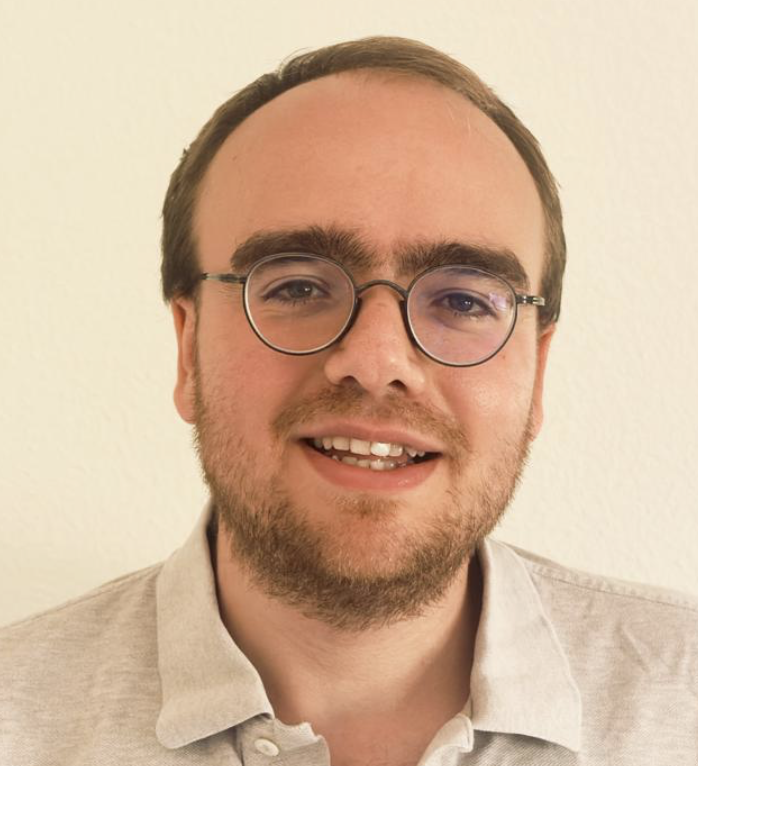
We are pleased to welcome the newest member of the QISS team: Matteo Fabbri is a postdoctoral researcher at the Institute for Logic, Language and Computation (ILLC), working on the QISS project, and a fellow at the Institute for Information Law (IViR), both at the University of Amsterdam.
His research focuses on platform regulation, the ethics of digital technologies, and cybersecurity policy. He has an interdisciplinary background, holding a BA in Philosophy from the University of Bologna, an MSc in Social Science of the Internet from the Oxford Internet Institute at the University of Oxford, an MA in Sociology and Global Challenges from the University of Florence, and an Advanced Master’s in Social and Political Sciences from the Scuola Normale Superiore.
Matteo completed his PhD in Cybersecurity at the IMT School for Advanced Studies Lucca, where his thesis examined the impact of the Digital Services Act on the transparency and user control of recommender systems.
Outside academia, he has worked at the BMW Group and the Joint Research Centre of the European Commission on issues at the intersection of digital technologies and regulation. -
QISS Skills and Technological Understanding
A new article by Eline de Jong and Sebastian De Haro has been published in the journal Synthese. In Technological Understanding: On the Cognitive Skill Involved in the Design and Use of Technological Artefacts they explore how we can better understand technology—not just as applied science, but as a domain with its own forms of knowledge, design practices, and explanatory frameworks. The paper contributes to ongoing discussions at the intersection of philosophy of science and technology, highlighting the distinctive nature of technological understanding, particularly in emerging fields such as quantum technologies.
-
Q-Day and Christian Schaffner in the News (in Dutch)

The University of Amsterdam has highlighted the growing importance of quantum security in a LinkedIn post, where team member Christian Schaffner emphasizes the need to prepare for the impact of quantum technologies. In addition, Christian underlines in a recent article on Tweakers that while the threats posed by quantum computers may still be some years away, action is needed now to ensure a secure transition. Finally, Christian has also been a frequent guest on Dutch BNR News, where he explains key quantum topics such as quantum computing and the implications of Q-Day for businesses and Bitcoin security. (all articles are in Dutch)
-
Brassard wins A.M. Turing Award
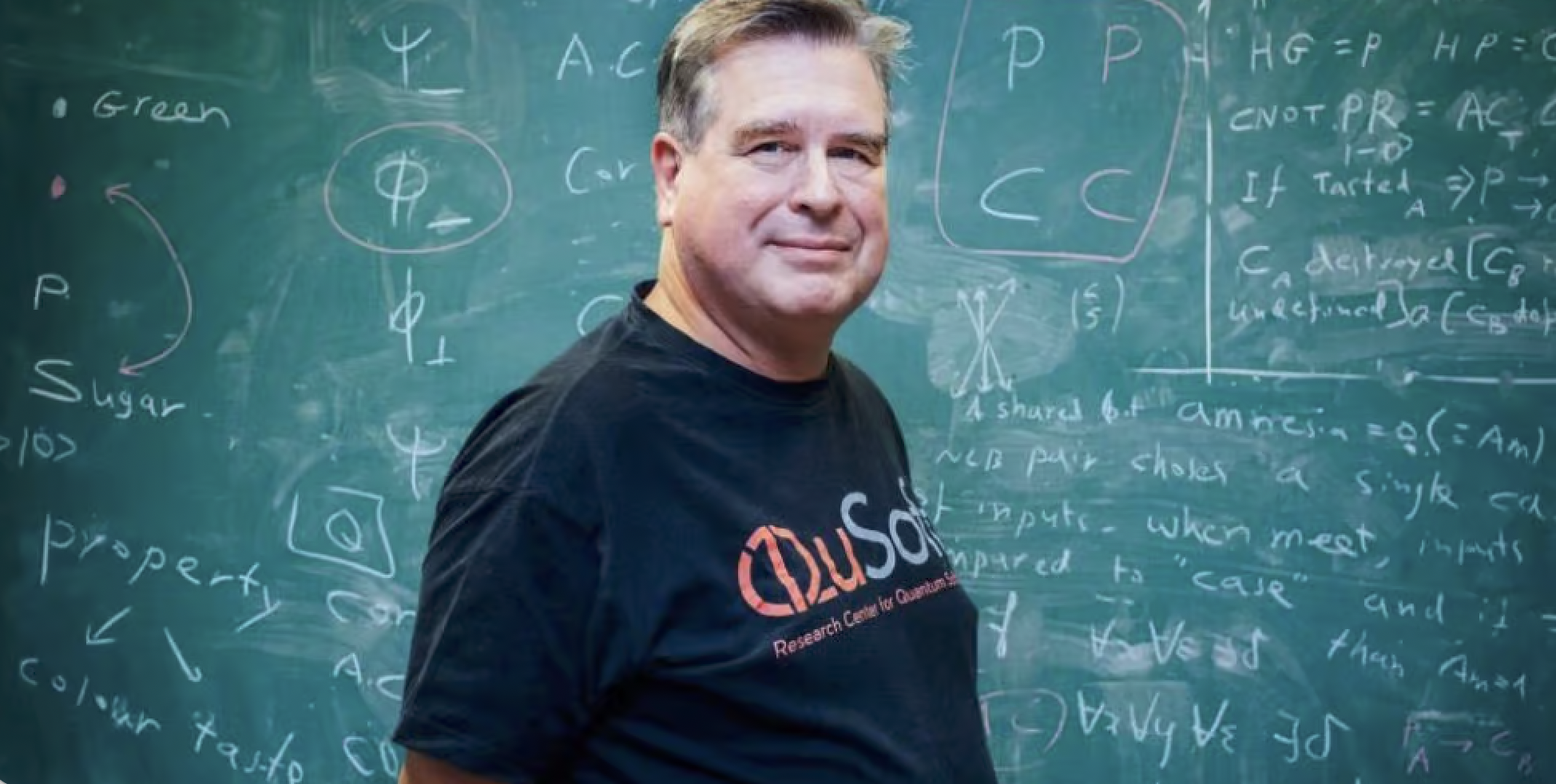
The 2025 ACM A.M. Turing Award—often referred to as the “Nobel Prize of Computer Science”—has been awarded to quantum computing pioneer Gilles Brassard. Brassard is a former QuSoft Turing Chair, highlighting the strong connection between QuSoft, a QISS partner, and leading advances in quantum research. This year’s award recognizes the growing importance and impact of quantum technologies in the field of computer science. (also here and here) -
Quantum Software Alliance
A new global initiative is putting quantum software firmly on the international agenda. With the launch of the Quantum Software Alliance (QSA), leading research centres—including QuSoft and aQa—are joining forces with partners worldwide to accelerate the development of quantum algorithms and software. The alliance reflects a growing recognition that, while advances in quantum hardware are crucial, it is software that ultimately unlocks the technology’s real-world value.
By fostering international collaboration and shaping a shared research agenda, the QSA aims to ensure that progress in quantum software keeps pace with hardware innovation. In doing so, it seeks to support the transition of quantum computing from experimental research to practical applications with societal and economic impact.
-
Quantum for Good. A case of technosolutionism?
Our QISS researcher Eline de Jong, together with Clare Shelley-Egan, has published a thought-provoking paper on the intersection of technology, ethics, and societal impact. In their article, they explore the question: Quantum for Good — what could possibly be wrong with that?
As Eline de Jong explains: “The reflex to turn to technology to address essentially social challenges has been pejoratively labelled 'technosolutionism'. On this critique, technosolutions are not really solutions at all: at best ineffective, at worst inventing the very problems they purport to solve. The real question is when a technosolution becomes morally problematic. Not only when it is ill-suited, or when problems are selectively “shopped for”, but also when it ignores, obscures, or depoliticises the underlying causes of those problems. How, in this light, should we appraise the ambition of Quantum for Good? It is technosolutionist, clearly: it reframes social problems as technological ones. But does that make it objectionable?
In our paper, Clare Shelley-Egan and I investigate this question. We argue that if Quantum for Good is to live up to its commitment — and become more than a normative veneer legitimising strategic innovation agendas — it must be open about the limits of quantum solutions for societal challenges and attentive to the sociopolitical and ethical dimensions of the problems it seeks to address.”
You can read the open-access paper here. -
QISS contribution to European initiatives on quantum-safe transition
QISS postdoctoral researcher Laima Jančiūtė has made significant contributions to the activities of the Centre for European Policy Studies’ multi-stakeholder Task Force on Strengthening the EU Transition to a Quantum-Safe World. The task force concluded its work in December 2025 with the publication of a report that examines the current state of play and outstanding challenges, and sets out a series of strategic, operational, and technical recommendations.
The aim of this collective effort was to highlight the technical, market, governance, and policy challenges involved in Europe’s transition to quantum safety. The report calls for an urgent acceleration of quantum-safe migration efforts across the EU.
 In addition, Laima contributed to a report by another European initiative, the Post-Quantum Cryptography Support Action, providing input on the governance aspects of the PQC transition process in the EU.
 -
'Net Echt' Podcast: Oppenheimer and Quantum
Net Echt is the podcast by the Universiteit van Amsterdam where films, series, and pop culture are examined through a scientific lens. In episode 20 Oppenheimer: Is Quantum the Next Atomic Bomb? the film Oppenheimer by director Christopher Nolan was the subject. Nuclear energy expert Machiel Kleemans and our QISS researcher Eline de Jong, discussed what moral dilemmas Oppenheimer faced, what can we learn from the way politics and science collaborated, and what lessons can this offer us for emerging technologies such as AI and Quantum.
Listen here to the postcast (in Dutch). -
QISS on the EU PQC Transition

Postdoctoral QISS researcher Laima Jančiūtė discussed the aspects of the post-quantum cryptography transition process in the EU on several occasions:
She was in May at the EU Digital Technologies and Policies conference in Brussels bringing together researchers, professionals, scholars, and policymakers, to discuss and enable exchanges and collaborations about broad-impact digital technologies in EU society and economy. It was organised by the Institut Polytechnique de Paris, and supported by the IEEE Society of Social Implications of Technology and academic networks EuroTech Universities Alliance and EuroTeQ University of Engineering.
In June she presented her work in a panel on National and Multi-National Initiativesat the ETSI/IQC Quantum Safe Cryptography conference in Madrid. While at the Brussels meeting of the Centre for European Policy Studies (CEPS) task force on 'Strengthening the EU transition to a Quantum Safe World Laima presented her work on the governance of PQC transition in the financial sector (key developments and the impact of DORA). The CEPS task force is working towards producing a report on the topic later this year. -
Bart Groothuis Guest in QISS course Quantum in Society
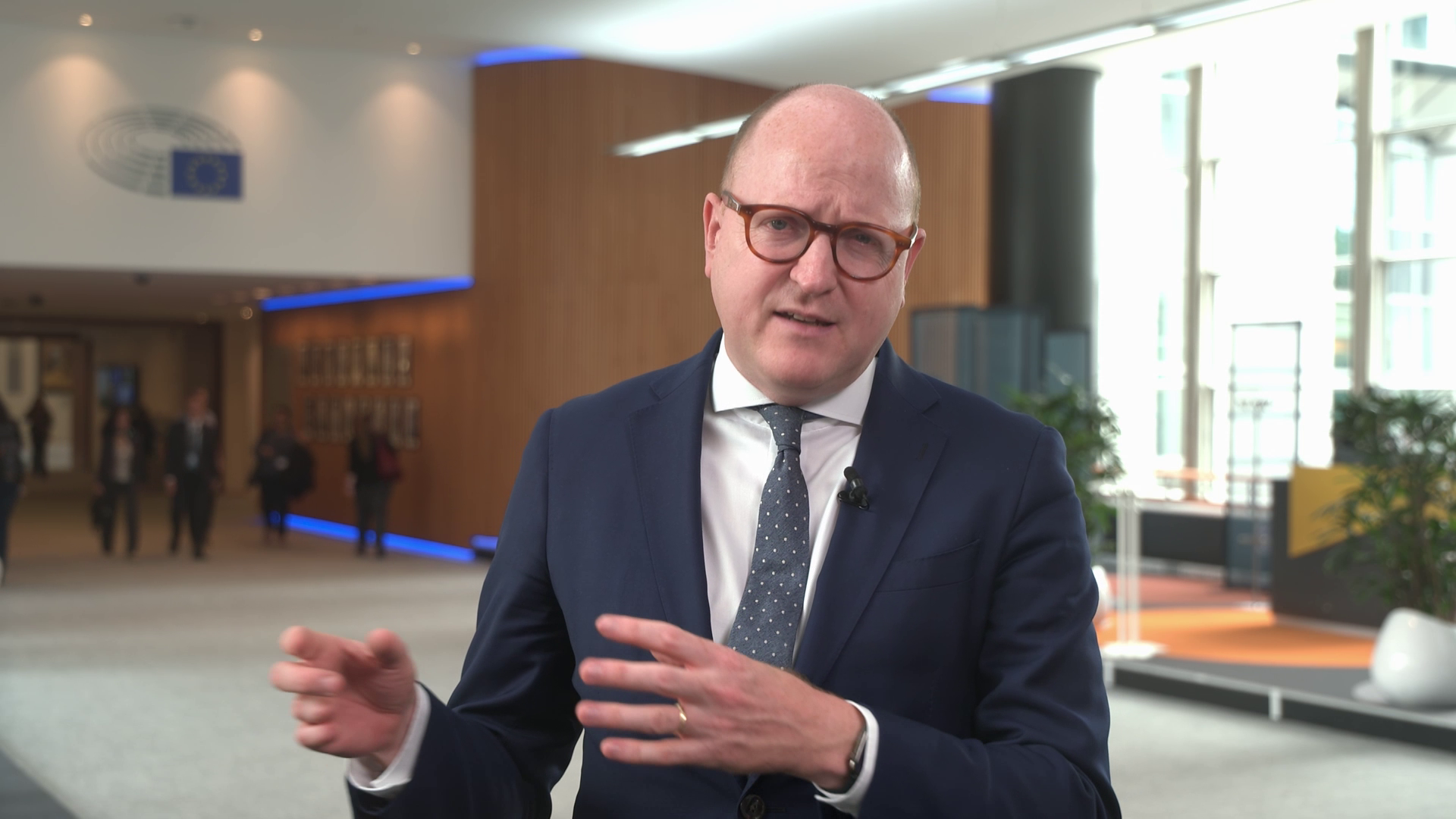
Bart Groothuis, member of the European Parliament, discusses the status of quantum business and the current geopolitical context in this video made especially for the UvA course Quantum in Society. Looking forward, Groothuis examines the political, technological, legal, and infrastructural conditions necessary for European quantum business to flourish. The Quantum in Society course is set up by QISS-lead Sebastian De Haro, in collaboration with Laima Jančiūte, and is coordinated and conducted by several QISS members in cooperation with the Institute for Information Law (UvA). Learn here more about the course and the UvA Master Quantum Computer Science.
-
A pint of quantum-safe cryptography!
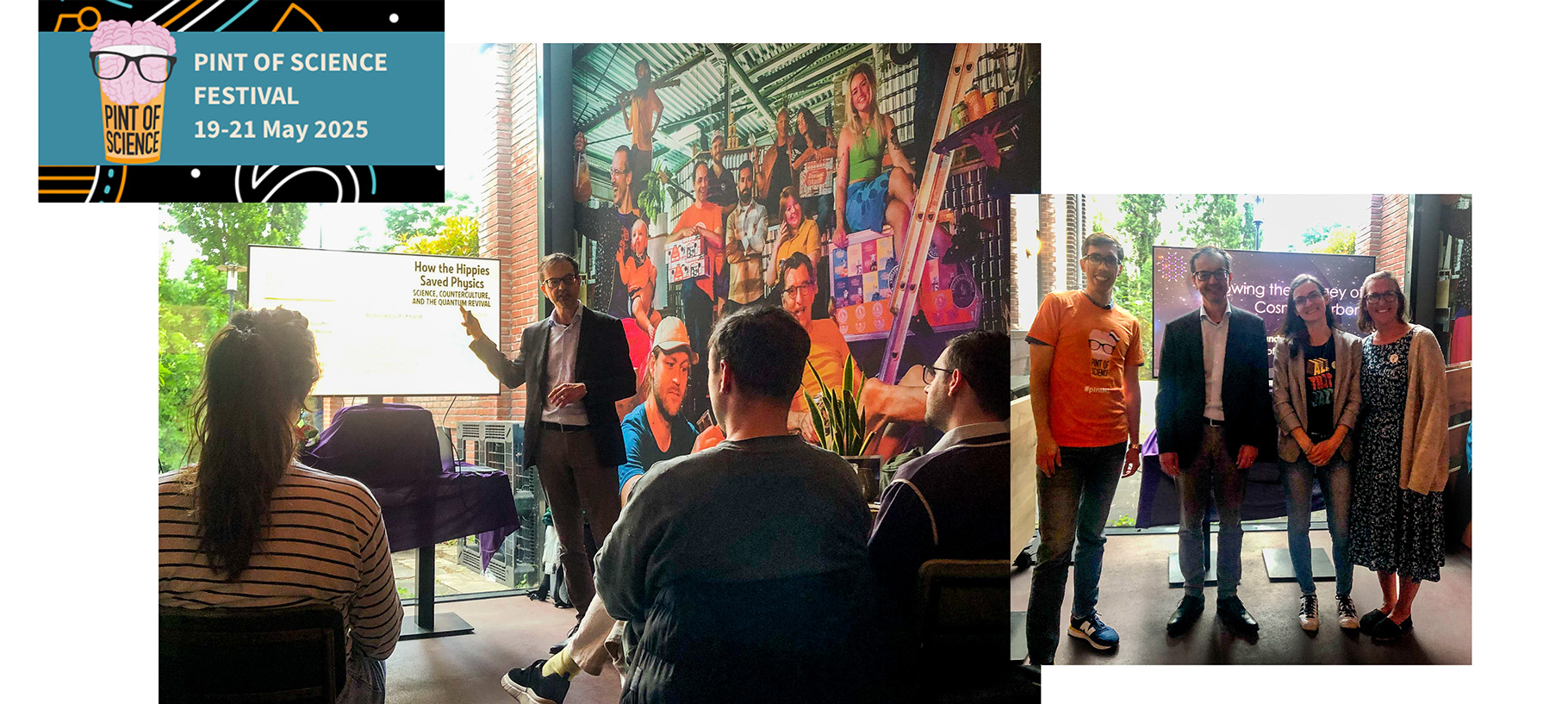 Sebastian de Haro gave during the Amsterdam Pint of Science Festival a sold out presentation at the brewery Poesiat & Kater. The enthusiastic audience learnt, with a beer nearby, more on the societal impact of quantum-safe cryptography. 'As the potential risks and consequences of cybersecurity breaches by future quantum computers are devastating, governments and organisations are already preparing for a transition to quantum-safe cryptography. However, as the development of other technologies illustrates, after an initial period of excitement, overhyped expectations can trigger disappointment and even withdrawal of resources, invoking technology winters that freeze further advancements.'
 -
New QISS research papers

Our QISS researchers have published several articles on responsible quantum technology and innovation. Most recently, Laima Jančiūtė’s paper Cybersecurity in the Financial Sector and the Quantum-safe Cryptography Transition: In Search of a Precautionary Approach in the EU Digital Operational Resilience Act Framework has been published in International Cybersecurity Law Review. In this paper Laima argues about the relevance of the precautionary approach to strengthening ICT security requirements and adopting quantum-resistant precautionary measures.
Eline de Jong and Sebastian De Haro have recently several articles available in pre-print that concern the nature of technological understanding and the ethics readiness of technology. On our articles page you will find all articles. -
The Rise of Quantum Software at UvA
 UvA has published an online article on the rise of Quantum Software, featuring QISS member Christian Schaffner on the quantum revolution that is taking place in cryptography: “The fact that the future quantum computer can use Shor’s algorithm means that most digital measures no longer suffice.”
 -
QISS presentation at FYSICA
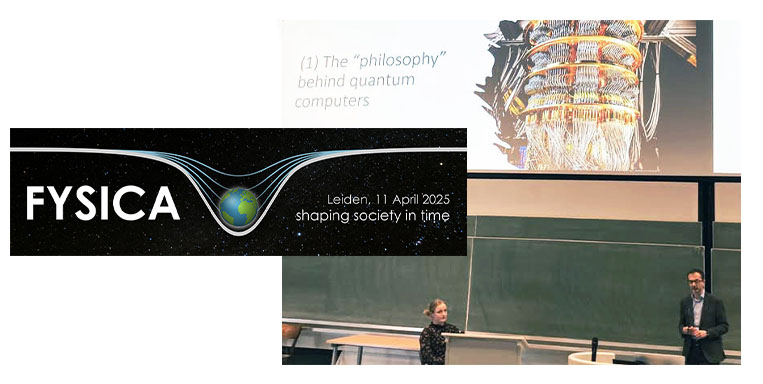
Sebastian De Haro and Ailsa Robertson gave a presentation at the FYSICA 2025 conference Shaping Society in Time. Their presentation The Societal Impact of Quantum-Safe Cryptography: Opportunities, Risks and the Path Forward dealt with the transition to quantum-safe cryptography, addressing common misconceptions and potential threats posed by quantum computers. They discussed the current quantum-safe cryptography ecosystem in the Netherlands, who are the main players, what role do they fulfill within the ecosystem, and what are the main challenges they face.
-
New research priority area: Shaping Interfaces Between Science and the Public
Our QISS project leader Sebastian De Haro is a PI of the recently awarded research priority area (RPA) Shaping Interfaces Between Science and the Public, which aims to establish a Public Methodology Centre to strengthen the relationship between science, citizen science, social debate and various professional practices. The RPA is a collaboration between the faculties of Humanities, Law, Science, Social and Behavioural Sciences, and the Amsterdam UMC. Read more about the RPA here, and stay tuned for the upcoming launch of the Public Methodology Centre.
-
Workshop on Ecosystem of Quantum-Safe Cryptography in the Netherlands
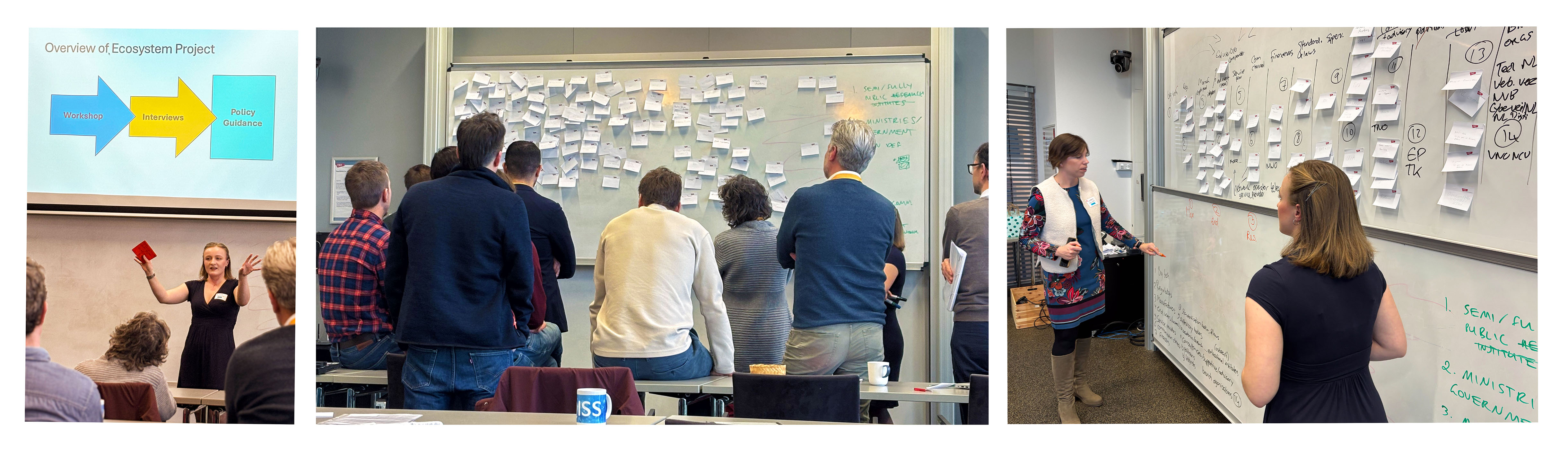 In January, QISS researcher Ailsa Robertson held an interdisciplinary multi-stakeholder workshop on the ecosystem of quantum-safe cryptography. The purpose of this event was to provide a source of data for the QISS 'ecosystem' project which will produce policy guidance for proactive management of the Dutch transition to quantum-safe. The event brought together a diverse group of participants whose collaborative spirit and enthusiasm made for a positive and productive atmosphere. Valuable insights and data were collected for analysis and will be used for an article.
 -
Quantuuuuhhm explained
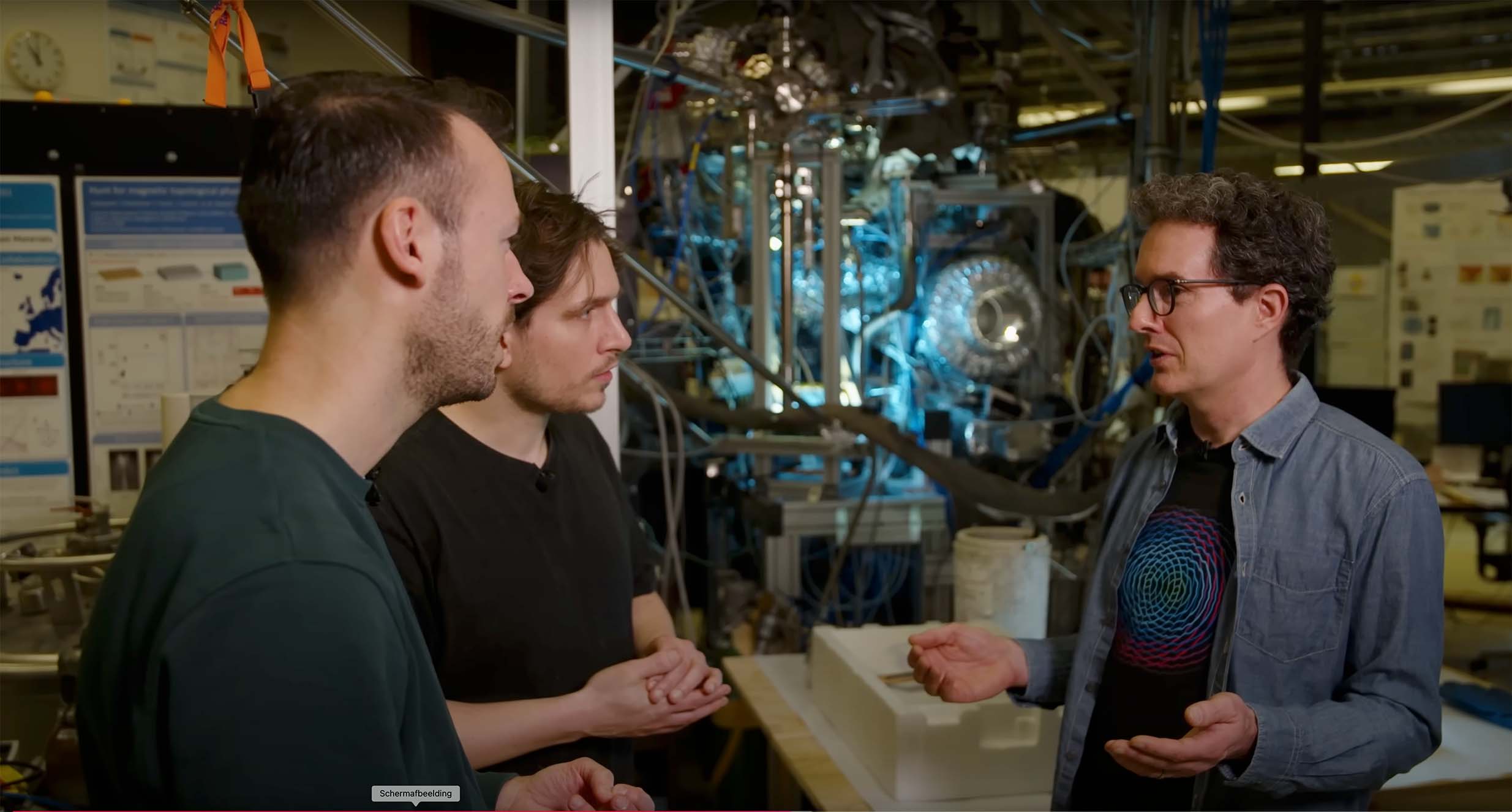
In the Quantuuuuhm Podcast episode ‘Hoe de quantumcomputer alles kraakt en veilig maakt’ presenters Sander Denneman and Adriaan ter Braack visit at the UvA our QISS member Christian Schaffner, who explains them more how Quantum computers work (in Dutch). View here.
-
Workshop on the Deployment of post-quantum cryptography
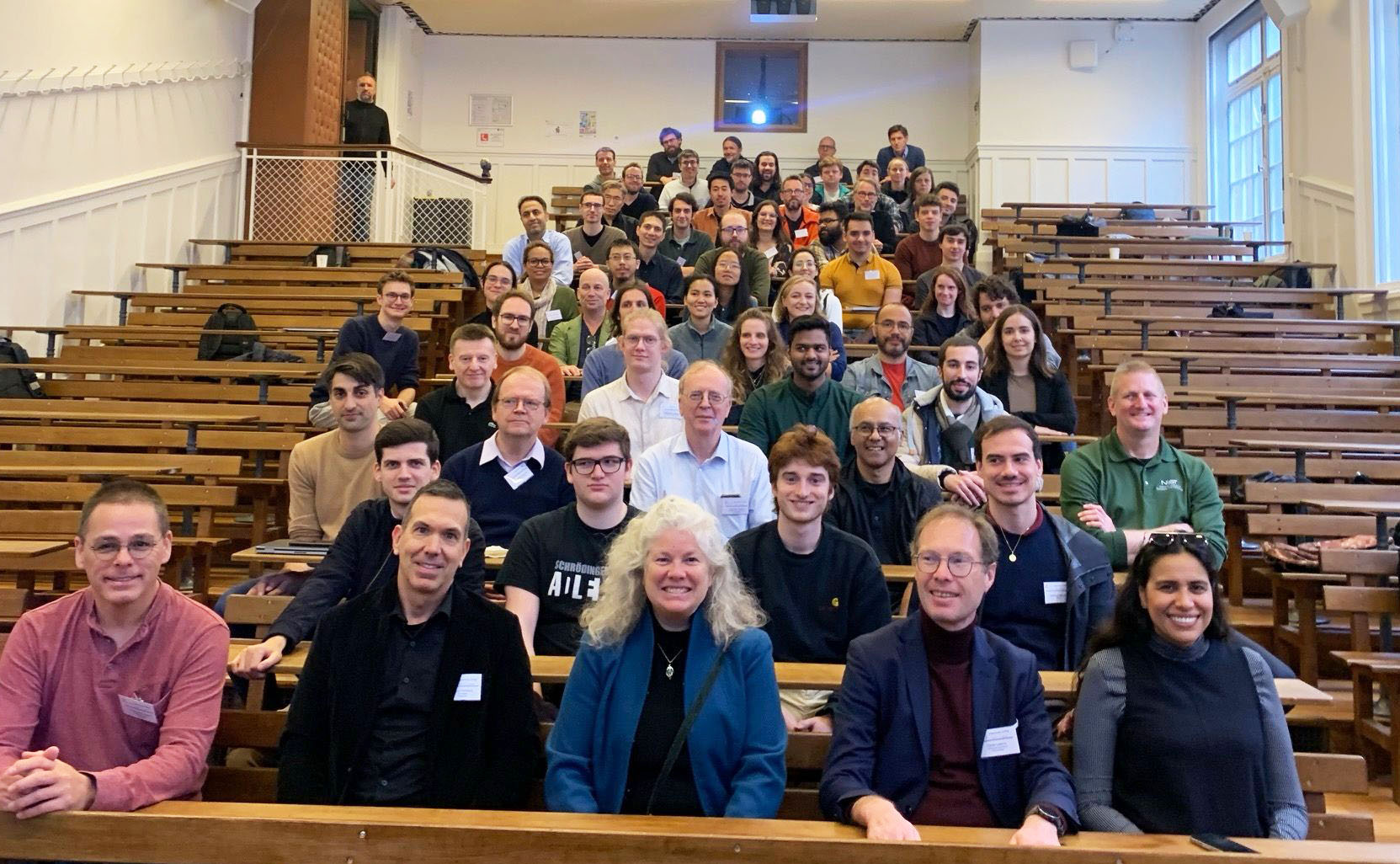
Ailsa Robertson attended early October a workshop of PQA Crypto Trimesterin Paris, serving as a forum to present and discuss the most pressing issues related to the practical deployment of Post-Quantum Cryptography (PQC). The program included skill-sharing sessions and open problem-solving discussions. Representatives from companies making the PQC transition were present, such as Microsoft (Christian Paquin), JP Morgan (Hubert le van Gong), Amazon Web Services (Matt Campagna) and Mike Ounsworth (Entrust).
-
Act Now! QISS Poster Winner at Alice & Eve
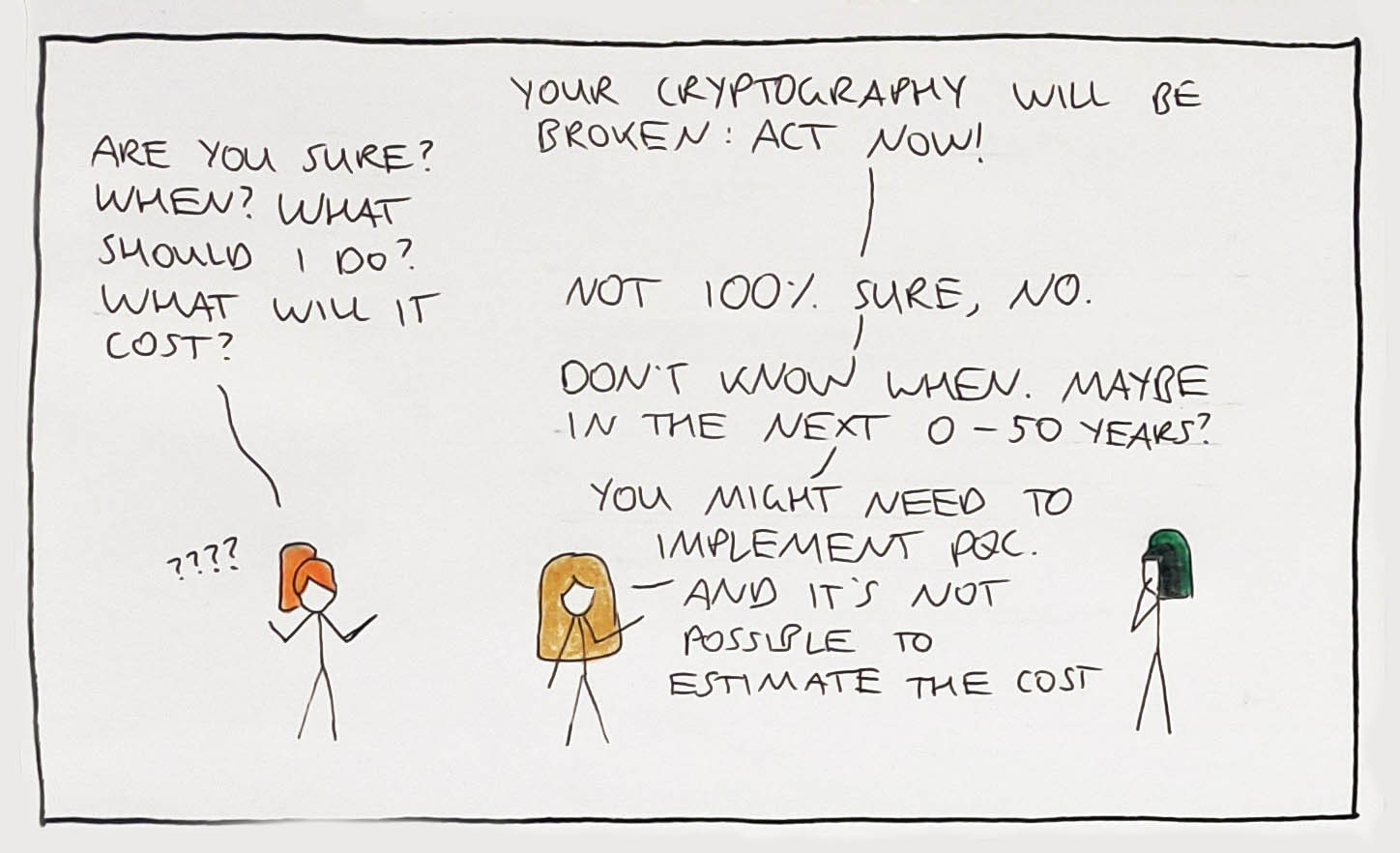
Our QISS researcher Ailsa Robertson won the poster competition presenting her QISS work at the Alice & Eve workshop in Leiden (25 October). Congratulations!
With her poster “Your Cryptography will be broken: Act Now!” Ailsa focused on bottlenecks and tensions of making the transition to quantum-safe cryptography in the Netherlands. Other topics at the workshop ranged from responsible research in Large Language Models, the role of gender in security decision making, to the ethics in computing.
See Ailsa’s full poster here. -
Giga-Open Quantum Institute event at CERN Geneva
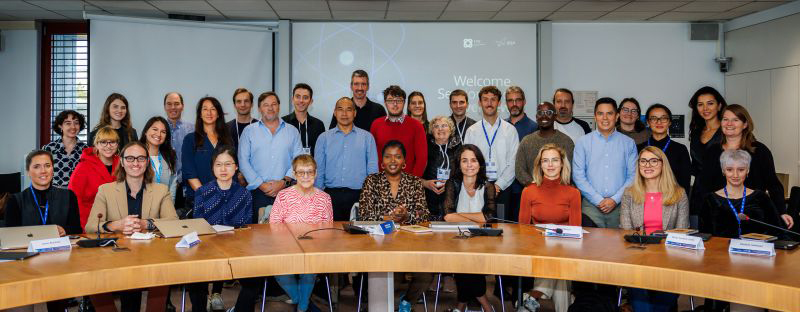
On 18 October, Giga—a global initiative to connect every school to the Internet by 2030— and the Open Quantum Institute—an initiative to connect quantum’s capabilities to the UN’s SDGs—, held an expert session titled “Quantum for Connectivity.” Eline de Jong was among the featured speakers, where she addressed both the practical and ethical implications of quantum technologies. In her talk, Eline outlined key structural challenges involved in embedding quantum technologies into society, highlighting considerations essential for responsible implementation. This session also served as a preliminary event for the upcoming “Quantum Humanity” conference scheduled for Spring 2025.